
CARGO insurance for goods transported in Moldova
CARGO insurance concerns transported goods, according to the risks and stages accepted in the policy. For a company in the Republic of Moldova, assessment starts with three questions: who has an interest in the goods, what is being transported and which route the goods take. A carrier's policy alone does not establish complete protection for the owner's shipment.
This article is for importers, exporters, manufacturers and distributors preparing a shipment or transport programme. It gives no universal rate and does not confirm acceptance of every commodity, country or operation. Use the questions below to describe the actual shipment and compare proposals using the same information.
Start with the company's role, not the truck registration
Record whether the company is the seller, buyer, owner of the goods, carrier or transport organiser. The same company may have different roles on different orders. If a customer requests a policy, ask for the exact requirement and identify the operation concerned. Do not send only a message saying that CARGO insurance is needed.
Separate sale documents from the transport contract. Show who bears the risk at each stage and which contractual points need checking; do not infer this only from who pays the freight invoice. If the moment of risk transfer is unclear, request legal review too. The broker should not invent an interpretation of the commercial contract.
CARGO and CMR answer different questions
In the local presentations consulted, CARGO concerns transported goods, while CMR concerns the road carrier's liability. Therefore, a carrier having CMR insurance does not by itself answer whether CARGO should also be discussed. Compare the protected interest, risks, limits, route and conditions of the actual documents proposed.
Request an explanation of the difference between the shipment's value and the liability limits being considered. Do not assume that the invoice value is automatically reimbursed in every incident. Describe own-account transport separately when the company moves its own goods. A generic product name does not resolve the particular circumstances of that operation.
Describe the goods clearly enough for assessment
A description such as general cargo may hide important differences. Prepare the goods' name, material, condition, packaging, number of packages, weight and value. State whether equipment is new, used or dismantled. Explain storage requirements for food. These are file-preparation recommendations, not a universal contractual document list.
Describe fragility, sensitivity to moisture, temperature requirements and contamination risks separately. Do not alter the description to obtain an apparently more favourable classification. An offer prepared for different cargo characteristics is not a useful comparison. Ask for confirmation of the accepted category and keep the description consistent across the documents discussed.
The declared value must be explainable
Prepare the invoice or other evidence of value and ask which valuation basis the insurer accepts. Check whether related expenses are included under the proposal. Do not automatically add percentages, freight, taxes or estimated profit. Show each value component separately so every provider assesses the same request.
For multiple lots, specify the maximum value in one shipment and how the goods are divided. Annual sales are not the same as the maximum value in a vehicle or transit location. Where currency is involved, ask which contract currency and calculation method apply.
Map the shipment's entire route
Write down the departure point, destination and known intermediate locations. Include stages where goods change vehicle or transport mode. A route from Moldova to an overseas customer may involve temporary storage, rail or a sea leg. Do not describe only the destination country when the actual operation has several stages.
State who organises loading and unloading, who holds the goods between legs and where the transport under discussion ends. Ask explicitly whether these operations are included, under which conditions and with which limitations. A warehouse-to-warehouse description is not a promise concerning every storage period or route deviation.
Packaging and securing are not decorative details
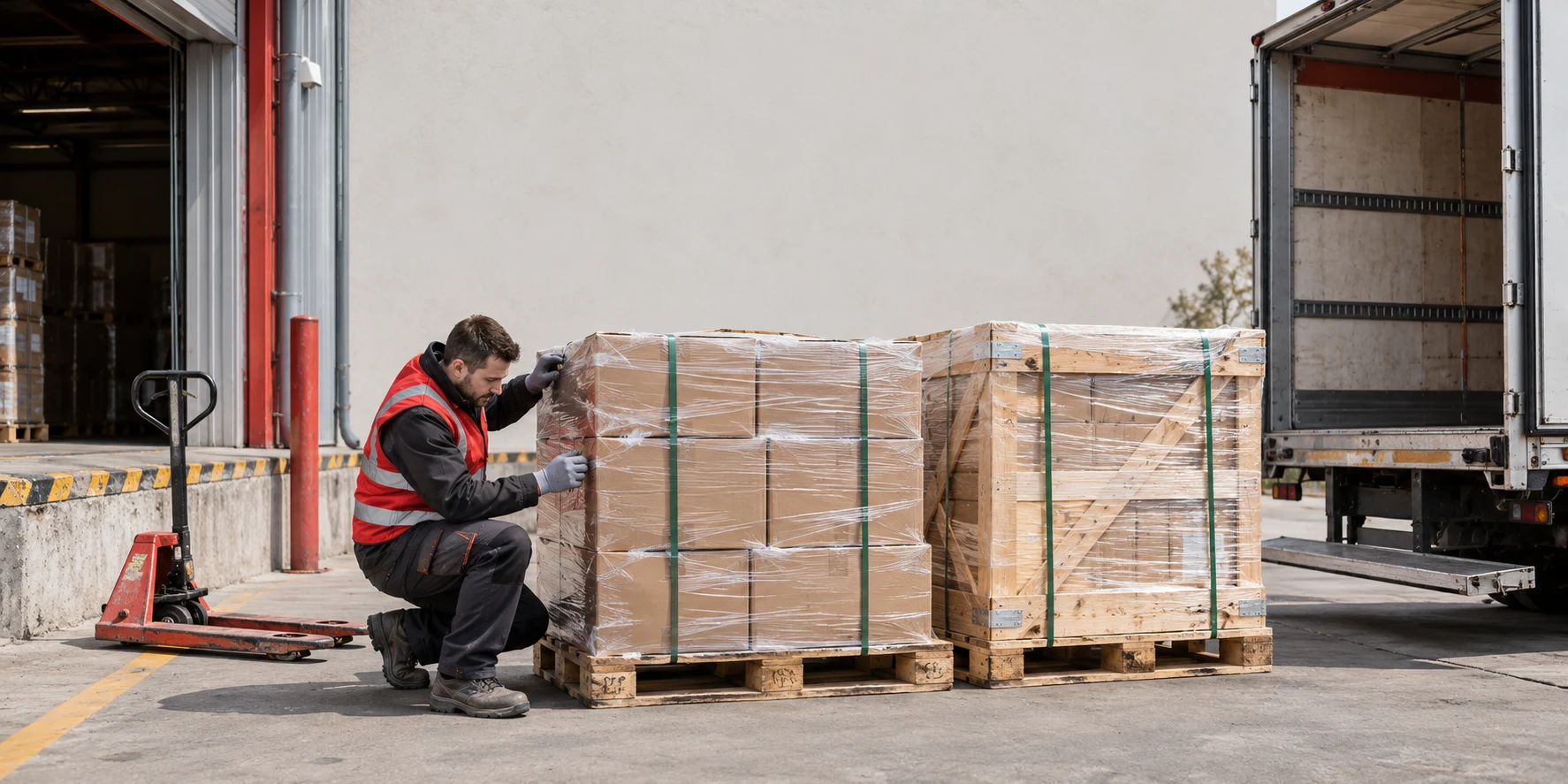
Describe the protection used: boxes, pallets, crates, containers, separating materials or securing systems. A clear photograph of packaging for a fragile item may assist technical discussion if sharing it has been agreed. Avoid photographs containing personal documents or commercial information unnecessary for assessment.
Ask what records of cargo preparation must be kept and which proposal requirements must be followed. Insurance does not replace transport organisation. Do not assume that a contract automatically compensates packaging, securing or temperature problems. Request an explanation of exclusions and duties for the specific situation before accepting the offer.
One shipment or repeated deliveries
For an occasional shipment, prepare that lot's details and schedule. For repeated deliveries, compile a programme summary: goods categories, countries, frequency, maximum values and transport modes. Do not describe an annual programme using only its simplest shipment if other deliveries have special requirements.
Ask which contractual arrangement can be considered and how each shipment is declared if that arrangement is available. Clarify when acceptance takes effect, how changes are handled and which operations require separate agreement. A public presentation about recurring transport does not automatically establish eligibility for your company's programme or all its destinations.
A preparation sheet for the shipment
Use the following list for internal discussion between logistics, sales and accounting. Do not fill gaps with invented information. For each unknown item, identify who can confirm it. Send documents through the channel agreed with the broker, not public comments, social-media screenshots or openly accessible links.
- The company's role and the person responsible for the shipment.
- The goods, packaging, quantity and substantiated value.
- Origin, destination and known intermediate legs.
- Transport modes and operators, where appointed.
- Loading, unloading, transshipment and temporary holding.
- Expected departure date and indicative transport duration.
- Special requirements and relevant incident history.
- Questions requiring written confirmation.
How to compare CARGO proposals and price
The insurance premium is the amount paid for insurance. Price should not be assessed separately from goods, value, route and conditions. Put proposals in a table and check whether the same stages and goods have been accepted. A cheaper total does not make an option equivalent when it omits an important operation.
Compare risks, exclusions, the deductible, limits and notification procedure. The deductible is the part of a loss borne by the insured under the contract. Ask for calculations using a hypothetical situation clearly identified as an example. Do not present an illustration as promised compensation or apply one insurer's conditions to the whole Moldovan market.
What to prepare if an incident occurs
Prioritise people's safety and lawful measures to reduce damage, then follow the instructions and deadlines in the applicable documents. Keep transport evidence, relevant photographs, correspondence and available findings. Do not borrow a numerical deadline from another product or assume that calling the broker replaces the insurer's required notification.
Separate observed facts from assumptions about cause or fault. Record when the problem was discovered, where the goods were and who was informed. Do not promise the final customer a compensation amount before the insurer's assessment. A broker can help clarify documents but is not the party that decides and pays compensation.
Changing the route or carrier after obtaining an offer
If a route segment, operator or transshipment point changes, do not rely solely on the initial application. Record the difference, when it became known and the shipments affected. Ask whether additional confirmation is required. The final invoice having the same value does not mean the original operational description remains complete.
Assign responsibility for communicating changes between sales, logistics and the broker. Separate discussions with another colleague may leave conflicting information in the file. Keep the request, proposal and confirmations accessible to authorised people. Do not disclose passwords or access to cargo-management systems to demonstrate a route change.
What to check when renewing a CARGO programme
Compare actual shipments with the description used in the previous assessment. Have products, destinations, suppliers or maximum values changed? Explain the differences before renewal, including relevant incidents and prevention measures. Do not automatically reuse the same sheet if the business has moved from individually packed goods to fragile or temperature-controlled loads.
Review responsibilities too: who declares shipments, retains documents and sends notifications when a problem arises. Clear procedures reduce internal misunderstandings. They do not guarantee a claim payment, but help the company provide consistent, verifiable information when the insurer reviews a file.
Frequently asked questions about CARGO insurance
Does CMR replace insurance for the goods?
Do not infer this from the carrier's policy. CMR and CARGO concern different interests; check the protected interest, limits and conditions in each document.
Is temporary storage automatically included?
Do not treat it as included without confirmation. Describe the location, duration and connection with transport, then check the accepted proposal.
Can I obtain a price from the invoice value alone?
Value is only part of the file. Goods, route, packaging, stages and requested risks must be described for a useful comparison.
Can I buy after damage has occurred?
Do not treat a new policy as a solution for an already known incident. Provide an accurate timeline and request a separate assessment without assuming acceptance.
Next step
Request a discussion with ING Broker to check assessment and intermediation possibilities. The broker intermediates and explains options; acceptance, conditions and claims decisions belong to the insurer under the contract. This article does not confirm product availability or cover for an individual event.
Read also: Transport and logistics insurance in Moldova, in Romanian.
Sources and limits of this information
- National Bank of Moldova: reading an insurance contract
- Moldcargo: local CARGO product presentation
- Moldcargo: CMR carrier liability presentation
The Romanian source consulted these sources on 8 November 2026. Preparation lists are editorial recommendations, not policy conditions. Examples belong to the cited providers and are not an ING Broker offer. Legal obligations and individual situations require specialist verification.