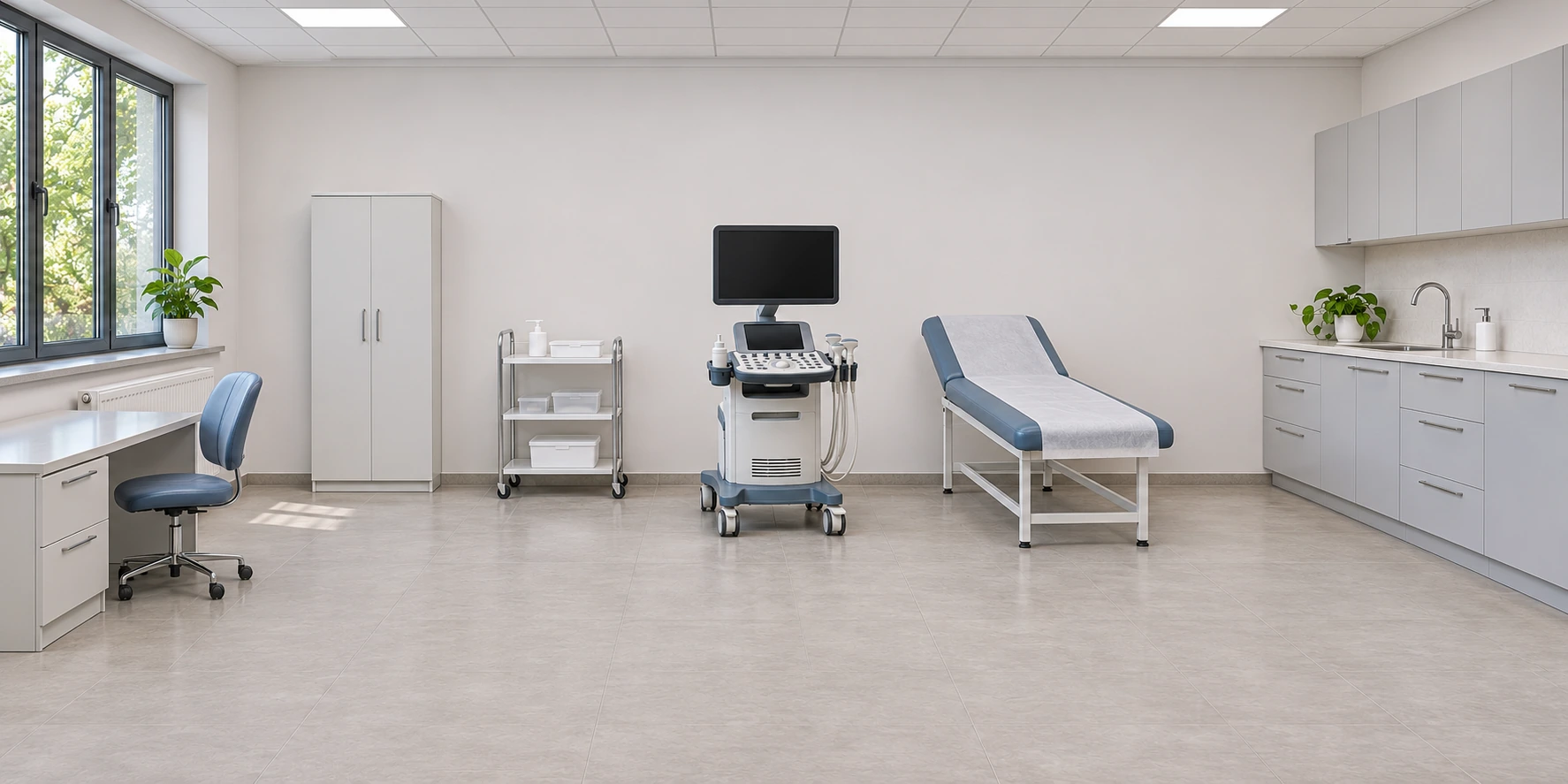

Insurance assessment for private clinics in Moldova
Insurance for a private clinic must be assessed separately for premises, equipment, professional activities and interruptions. A damaged device and a claim about medical services are not the same situation. Property insurance does not automatically establish professional liability or data-loss protection.
This article helps clinic managers in Moldova prepare a risk file without patients' personal information. It offers no medical services or treatment advice and does not confirm a package for every clinic. Assess each component's eligibility and conditions separately.
Begin with services actually delivered
Prepare the activities actually carried out at each location: consultations, investigations, sample collection and other existing services. Do not treat a general description such as medical centre as sufficient. The actual services, equipment used and people involved determine the questions to ask during initial assessment. Describe existing work, not services that are merely planned.
Record what the clinic performs itself and what is delivered by partners, external laboratories or specialists working under separate agreements. Do not infer from a shared reception that every entity has the same interests or liability. Keep relevant documents for specialist review so the parties and their roles can be distinguished accurately.
Rented premises and clinic improvements
If premises are rented, separate the landlord's building from the operator's investment in partitions, finishes, networks and furnishings. Check use documents and the work carried out. An insurance requirement in a lease does not alone confirm that the proposal includes all improvements made by the clinic. Ownership and the proposed insured interest need their own checks.
Describe address, floor, area and differently used rooms, including technical and storage spaces. Identify rooms at other addresses separately. Mark unknown installation details and obtain evidence rather than using optimistic information to accelerate assessment.
Inventory medical equipment
For important devices, prepare the manufacturer, model, serial number where needed, year and value documents. Separate owned property from leased, rented or borrowed equipment. A clear inventory identifies which device is in each room and which entity holds the relevant interest. Similar equipment should not be combined in a way that obscures ownership or location.
List accessories and components without which the device cannot operate. A single total for medical equipment can hide important differences between items. Do not include patient information or investigation screenshots to demonstrate that equipment works. Identifying a physical asset and assessing personal-data matters are separate subjects, with different information needs.
A technical failure is not every cause of non-operation
Separate physical damage caused by an external event from internal breakdown, wear or maintenance problems. Ask for explanations of causes accepted in the proposal. An unavailable device is not automatically a device with an insured loss, regardless of the technical reason eventually identified. A service description and a contractual cause must not be treated as interchangeable.
Keep available installation, maintenance and repair records. Ask what documents may be required for assessment without assuming the same rule applies to all products. A supplier warranty, service agreement and insurance have different roles. The existence of one does not automatically establish the scope of another or the treatment of the particular fault.
Check values alongside reinstatement costs
The sum insured is the contractual amount for the assessed property or interest. Clarify the accepted basis: purchase evidence, valuation or another method. Accounting value and replacement cost are not necessarily equal, especially for devices purchased in different years.
Ask separately about transport, installation and commissioning of a replacement if these matter for the clinic. Do not add those costs as if payment were confirmed. Check whether and in what form the actual documents provide for them, alongside limits and exclusions. Keep these expenses distinct from the value assigned to the device itself.
Refrigerators and temperature-sensitive materials
If the activity uses products or materials needing special storage, describe their categories and values without patient information. Separate refrigeration equipment from its contents. Loss of a material and damage to a device raise different questions for a possible proposal. Their presence in the same room does not make them one insured item.
Request clarification of causes, monitoring and documents needed for the situations considered. This article gives no clinical storage instructions and does not confirm insurance of biological samples. Do not automatically transfer property-policy conditions to special materials merely because they are kept at the same address. The relevant interest and conditions require separate identification.
Professional liability requires a separate check
A claim relating to a medical service needs assessment separately from building or equipment damage. For the initial discussion, prepare the services, entities and professional categories involved. Do not state that an institution's policy automatically protects every person practising at the address. Identify the actual people and activities in the proposal.
Read the included persons, activities, territory and relevant periods in the proposal. Seek specialist review of notification rules and reporting of claims. This article does not determine medical fault, promise payment for every complaint or confirm intermediation of a professional product for all specialties. A general institutional description cannot resolve those individual checks.
Visitors and general liability
Reception areas, corridors, stairs and parking are used differently from the delivery of medical treatment. An incident involving a visitor's access should not automatically be classified as professional error. Explain who manages each area and which activities, such as cleaning or building maintenance, are outsourced. Record the relevant roles without assuming legal liability.
Ask for these questions to be distinguished in general-liability assessment. Both categories containing the word liability does not mean one replaces the other. Establishing a legal obligation and verifying insurance cover are separate tasks. The contracts and documented circumstances matter for both, but the conclusions are not automatically the same.
Protect data without sending it in the request
Describe essential applications, providers and continuity generally. Do not attach patient files, names, passwords or databases. A public contact form is not the place for a complete sensitive case file.
Physical equipment insurance does not automatically pay cyber-incident costs. If needed, separately check the availability and conditions of a suitable solution. Insurance is not a substitute for security measures or data-protection obligations.
Appointment continuity after equipment damage
Identify the device or room without which an important part of services cannot continue. Record real alternatives, known service timing and dependence on a single provider. A list of devices does not by itself explain how the clinic can reorganise operations during unavailability. Keep an unconfirmed alternative or repair estimate clearly labelled as such.
Prepare confidential communication and separate clinical from commercial decisions. Any business-interruption component has its own triggers, periods and financial evidence. Cancelled appointments and reduced receipts are not automatically insured losses.
Compare conditions as well as the premium
The insurance premium is the amount paid for the contract. The deductible is the share of a loss borne by the insured in the form specified in the conditions. Ask for explanations of category limits, exclusions and the treatment of each essential device or interest under consideration, rather than relying only on an overall sum.
Use identical clinic descriptions and values. Lower premiums can mean fewer devices or activities. This article offers neither per-doctor or per-patient tariffs nor minimum prices or promised compensation.
Preparing and updating the assessment file
Organise activities, locations, inventory, value evidence and known incidents. Appoint equipment and financial contacts. The list starts discussion but does not guarantee that providers will request no further evidence or checks.
Update when adding services, devices or locations. An older assessed situation does not automatically extend to growth. Keep dated versions and request explanations before treating every activity and item as included.
Illustration: an essential device becomes unavailable
A hypothetical clinic has one device for a category of investigations. Management documents equipment and service contract while staff prepare operational alternatives. Insurance discussion separates device cost, reorganisation and professional-service issues rather than one unexplained consequences total.
This is not a real patient or client and establishes no universal cover. It shows why clinics need a dependency map, not only prices. Insurer conditions and case documents remain decisive for any claim.
Devices moved, loaned or temporarily replaced
Record dispatch to service, transfer to another location and temporary replacement. Inventory value does not establish cover in transit or at another address. Ask about these stages before relying on unchanged conditions.
For a replacement, check ownership, period and documented duties. Supplier property does not automatically replace owned equipment in the insurance contract. This identifies information gaps without promising every movement can be insured.
Frequently asked questions about clinic insurance
Does property insurance include professional liability?
Do not assume so. Check property and professional claims separately, identifying people, activities and applicable rules.
Can I send patient files initially?
Do not send sensitive information through a public form. General services and property inventories are a starting point. Justifiably requested sensitive documents need suitable channels and authorised recipients.
Is every device failure insured?
No. Cause, property, maintenance and conditions must be checked. Non-operation alone does not establish an accepted event.
Does the broker decide whether compensation is paid?
No. The broker intermediates and explains steps. The insurer assesses acceptance and claims under the applicable contract and documents.
Next step
Request a discussion with ING Broker to check assessment and intermediation possibilities. The broker explains options; acceptance, conditions and claims decisions belong to the insurer under the contract. This article does not confirm availability or individual cover.
Read also: Professional liability is separate from property.
Sources and limits of this information
The Romanian source consulted these sources on 9 November 2026. Lists are editorial recommendations, not policy conditions. Examples are not an ING Broker offer. Legal obligations and individual situations require specialist verification.