
Insurance for a company's IT equipment in Moldova
IT equipment insurance concerns identified property and events accepted in the contract. Laptops, servers and network devices are not the same as data, software or liability arising from a cyber incident. For a Moldovan company, the first check is whether the inventory and actual use of equipment are correctly described in the proposal.
This article is for company managers, IT staff and people responsible for equipment. It does not confirm protection for every breakdown or attack. Its purpose is to help prepare useful records and clear questions about locations, travel, values and conditions. Acceptance of equipment and requested risks must be checked individually with the insurer.
Start the inventory with identifiable devices
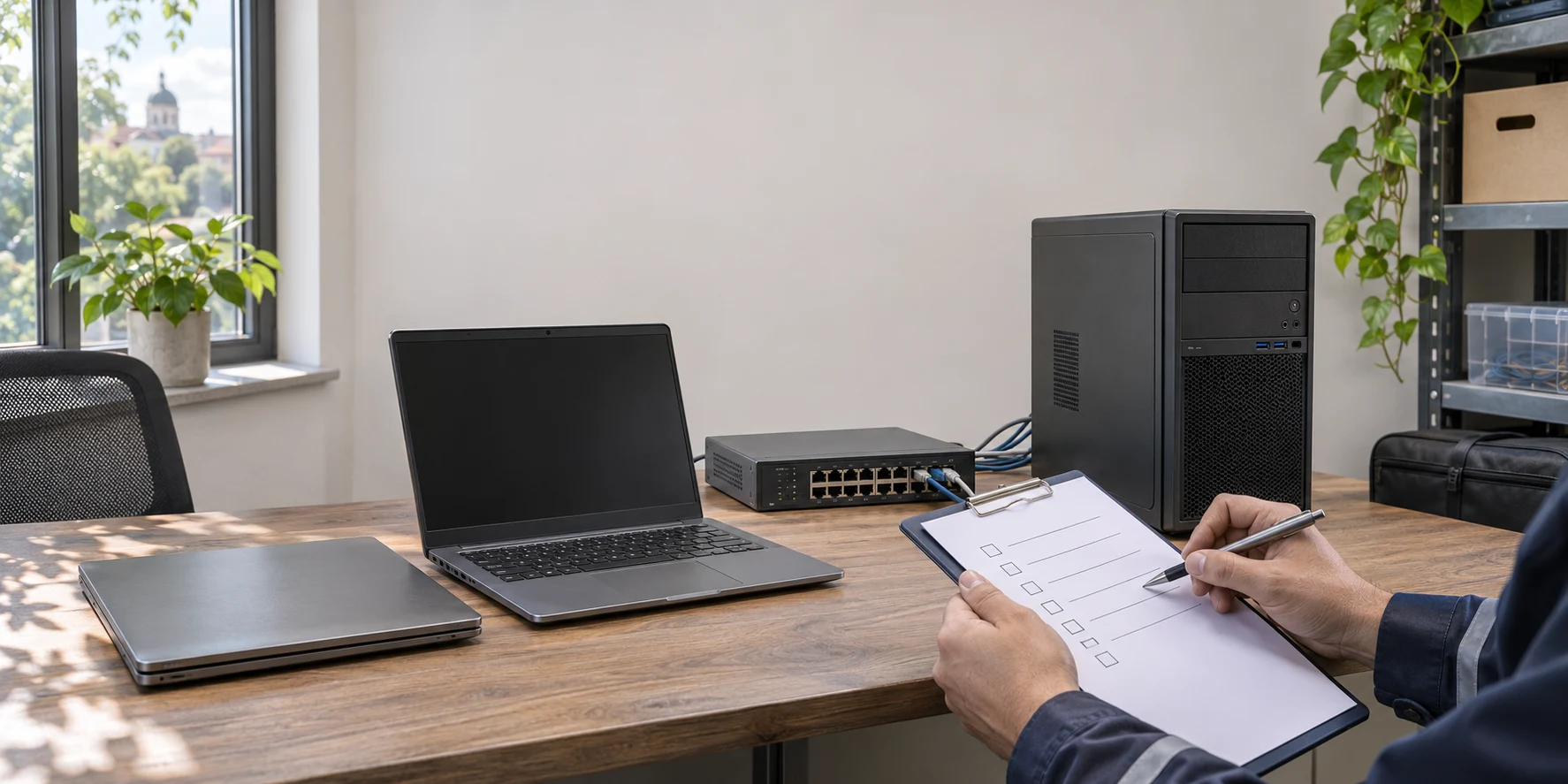
List the laptops, computers, servers, monitors and network equipment being considered. Include serial numbers, models, years and owners where available. A list saying ten computers may be insufficient when devices differ considerably in value, use and storage location.
Separate company property from employees' personal devices and rented equipment. Explain which components are used together and which accessories have significant value. Do not assume that a declared workstation automatically includes all peripherals or later additions. Ask for confirmation of the accepted inventory and how it should be updated.
Where equipment is used and kept
Record offices, work sites, shared spaces and locations where devices remain outside working hours. Describe home-working arrangements accurately without unnecessarily disclosing personal addresses. Establish the detail needed for assessment and an agreed channel for sensitive information.
Do not assume a laptop is protected everywhere simply because it appears in the company's inventory. Ask about use outside the premises, temporary storage and travel. A proposal for property at a fixed location does not confirm every mobile situation. Request an explanation of territory and relevant conditions before comparing costs.
The device's value and the cost of returning to work
Prepare invoices or other supporting documents and identify comparable equipment if required. Ask which valuation basis applies to new and used devices. Do not assume that the original invoice amount will always be paid in full. Calculation depends on the documents under consideration.
Separate the equipment price from configuration, installation, data recovery and temporary-device rental. These expenses raise different questions and should not automatically be combined. For a specialist workstation, explain its business function and replacement requirements without promising that every component is insurable.
Physical breakdown is different from a cyber incident
A power problem, damage to a device and compromised accounts are different situations. The term IT equipment does not establish cover for cyberattacks, online fraud, data loss or customer claims. Describe each exposure and ask which product can be considered for it.
Conversely, discussing cyber risks does not establish that every physical computer is included. Distinguish property and consequences: repair, replacement, information access, interrupted operations and potential third-party claims. This article does not confirm one policy that resolves all those elements.
Servers, networks and electrical supply
For essential equipment, describe location, use and technical dependencies. Record existing backup power, cooling and maintenance without inventing inspections or certifications. Identify equipment whose failure could stop the whole company, not only the item with the highest accounting value.
Ask about requested risks and proposal requirements. An editorial checklist is not a mandatory technical standard or a security audit. Use qualified specialists for findings about electrical installations or IT infrastructure. The broker needs a risk description, not passwords or administrative access.
Laptops used while travelling require separate questions
State whether devices are used at customer sites, in transit or on foreign trips. Explain who receives them and the handover procedure. Do not send names and personal details if an aggregate description is sufficient initially. Detailed identification should be provided only as needed for agreed documentation.
Ask how vehicle storage, baggage, unattended locations and courier transport are treated without assuming inclusion. Do not copy travel-policy conditions onto company equipment. If a device is sent for repair, clarify the stages and parties involved before dispatch.
Data and backups remain operational responsibilities
Separate the property inventory from management of the information held on it. Identify who administers backups and the procedure for restoring access. Do not send customer databases, document copies, credentials or server contents to request a general insurance assessment.
A new device does not automatically restore data and applications to a usable state. Prepare an internal estimate of recovery steps and ask which expenses could be considered for protection. Do not promise complete data recovery or present insurance as a substitute for prevention, administration and technical checks.
Read warranties, maintenance and insurance separately
Keep supplier documents and maintenance descriptions. Explain previous repairs and known defects. A commercial warranty and an insurance contract do not automatically have the same conditions. A device remaining under warranty does not establish that a particular breakdown qualifies under insurance.
For used equipment, ask about required technical information and valuation. Mark missing documents and ask which alternatives may be accepted. Do not guess serial numbers or values. Verifiable records are more useful than an apparently complete but inaccurate inventory.
What affects a meaningful price comparison
The insurance premium is the amount paid for insurance. Compare offers for the same property, values, locations and requested risks. If an option excludes use outside the office or a device category, keep that difference visible. A smaller total is not proof of an equivalent proposal.
Check the deductible, meaning the portion of a loss borne by the insured, as well as limits and exclusions. Ask whether some expenses require approval or have separate limits. Request a hypothetical calculation relevant to the company. Do not interpret the example as confirmed compensation for an actual or future breakdown.
When devices are purchased or replaced
Assign responsibility for inventory updates. Retain documents for purchases, replacements, disposals and moves, and ask whether insurance must be amended. Do not assume a new device becomes protected merely by physically replacing the old one. Read the accepted proposal's mechanism and obtain necessary confirmations.
At renewal, compare the current inventory with the last submitted version. Check changes in working patterns, offices and mobile-device numbers. Do not automatically send last year's sheet if the company has switched to distributed work or moved its infrastructure. Describe operational changes rather than hiding them within the same total value.
Plan the return to work, not only a laptop purchase
For each essential role, establish which temporary device can be used and who configures it. A laptop in a cupboard may not be ready for accounting, design or management software. List required application categories without licence keys, passwords or customer data. Check whether safe work can continue while equipment is repaired or replaced.
When sending equipment for repair, retain a record of the device and accessories. Discuss information protection with IT staff before intervention. A repair request, supplier documents and an insurance file serve different purposes; do not automatically send the same sensitive information to every party. Record configuration and rental expenses separately so their contractual treatment can be clarified.
Internal IT equipment assessment sheet
- Equipment categories, models and available identifiers.
- Ownership, value documents and rented-device arrangements.
- Locations, use outside the office and travel.
- Equipment essential to business operations.
- Maintenance, warranties, servicing and known defects.
- Separation of physical devices, data, software and cyber risks.
- Temporary working arrangements and recovery steps.
- Questions about limits, exclusions and claims notification.
The sheet helps organise discussion; it is not a contractual form and should not be published with company information. Send only necessary information through the agreed channel. Insurance ING Broker SRL is an insurance broker. Assessment, risk acceptance and claims handling follow the insurer's documents without promises of guaranteed repair or replacement.
Frequently asked questions about IT equipment insurance
Does computer insurance also protect the data?
Do not assume this. Physical property, data and cyber risks must be distinguished and checked in the specific conditions.
Is my laptop protected while I work at a customer's site?
Request confirmation of use away from the declared location, territory and conditions. Inclusion in the inventory alone is insufficient.
Does supplier maintenance replace an insurance policy?
Compare the documents and situations they address separately. A maintenance service does not establish insurance cover.
Can the matter be assessed without a device list?
Ask what the product being considered requires. For a useful comparison, property and its use must be described sufficiently clearly rather than only as a total sum.
Next step
Request a discussion with ING Broker to check assessment and intermediation possibilities. The broker intermediates and explains options; acceptance, conditions and claims decisions belong to the insurer under the contract. This article does not confirm product availability or cover for an individual event.
Read also: Cyber risks for companies.
Sources and limits of this information
- National Bank of Moldova: what to check before signing an insurance contract
- MOLDASIG: property and accidental equipment breakdown
The Romanian source consulted these sources on 8 November 2026. Preparation lists are editorial recommendations, not policy conditions. Product examples belong to the cited providers and are not an ING Broker offer. Legal obligations and individual situations require specialist verification.