
Art insurance: identification, valuation and exhibition loans
Insurance assessment for a painting, sculpture or collection starts with identification and documented value. An attractive photograph and the owner's estimate are not enough. In Moldova, storage, condition, exhibition use and transport also need clarification. General property insurance does not automatically establish protection for every artwork.
This material helps owners, galleries and organizers prepare information. It does not authenticate works, provide market valuations or confirm availability for every collection. Provenance, value, conservation and legal requirements need appropriate specialists. The broker explains and arranges available options; conditions and claims handling belong to the insurer under the contract.
Identify objects without exposing the collection publicly
Prepare a record describing the work, dimensions, materials and relevant identifying features. Add available acquisition and valuation documents without treating a catalogue title as proof of authenticity. Distinguish established information from attributions still needing verification. The reviewer needs to know exactly which object is being discussed.
Do not publish a complete inventory together with addresses and security details. An initial conversation may need only categories and purpose, followed by the necessary assessment list. Agree a channel for sensitive documents. Insurance does not justify sharing certificates, routes or information exposing the owner and property with any recipient.
Explain the basis of a declared value
Ask which valuation documents are needed and what a proposed sum means. Purchase price, a recent appraisal and an exhibition-loan value can serve different purposes. An online sale result is not a valuation of your work. Ask how the insurer considers value and any required updates.
For several objects, check individual or group identification and applicable limits. A large total sum does not automatically make the entire amount available for any one piece. Ask about sublimits, conditions and claim documents. This article does not calculate art prices or recommend inflating values to obtain higher compensation.
For a preliminary comparison, record one object's identifying description and the source of its value. Keep confirmed provenance separate from unverified attribution. Then list each proposed location and operation, including any intermediate storage. This organizational aid is not an appraisal and should not contain publicly accessible security details.
Record condition before insurance and handover
Keep known-condition information, earlier interventions and relevant fragilities. A specialist report may serve a different role from owner photographs. Request the document list for the actual object and circumstances. Do not hide pre-existing damage or assume a new policy resolves an already visible problem.
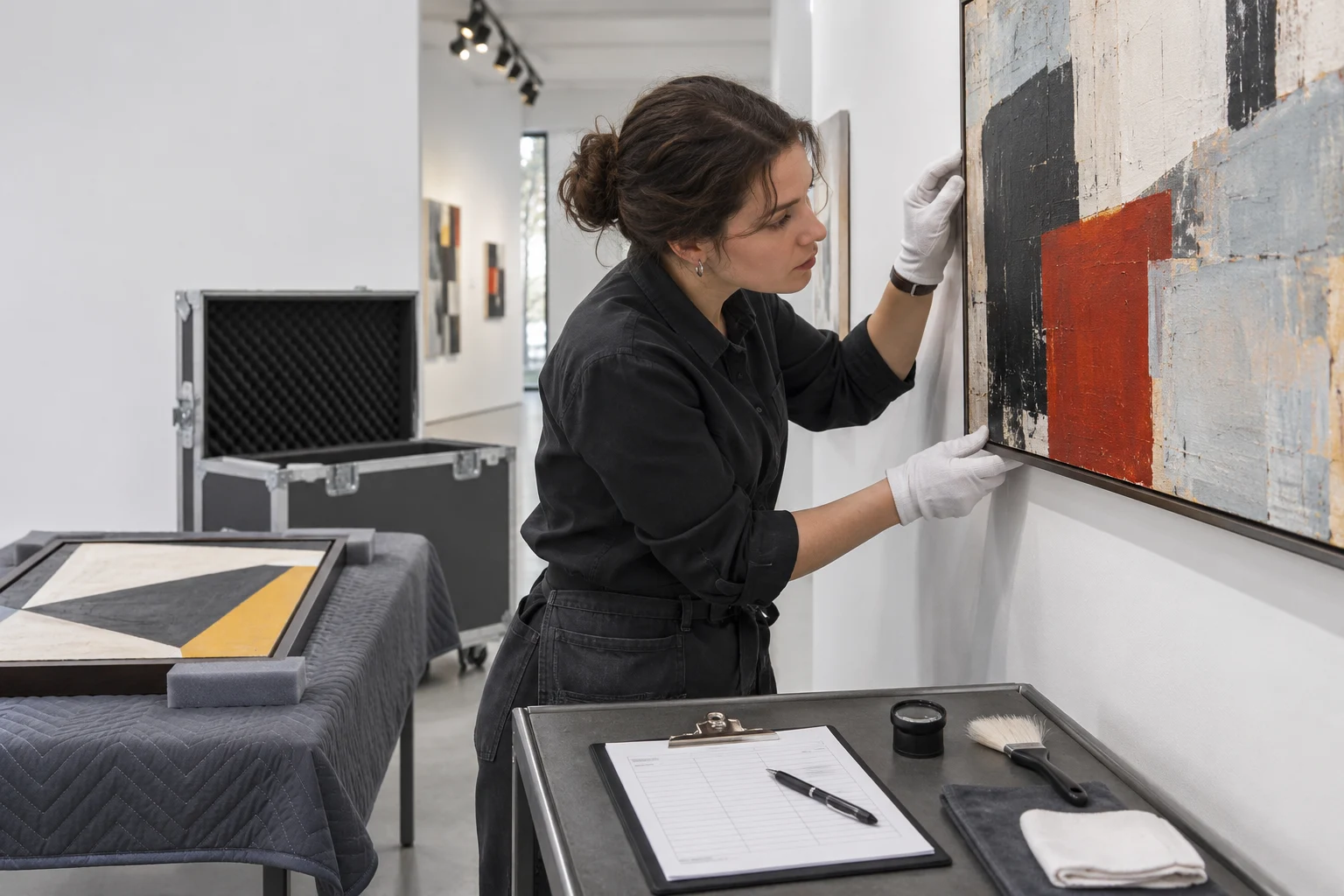
For handover to an organizer or carrier, agree who records condition and which copies each party receives. This helps trace chronology without independently establishing the cause of later damage. Do not clean or repair an object merely to improve the submission. Conservation and restoration need specialists competent in its materials.
Home storage differs from gallery display
Describe location and use: private collection, workplace, gallery, temporary exhibition or store. Check addresses and dates. Moving a work between two premises of the same owner is not automatically accepted by every contract. The object remains the same, but storage circumstances and custodians change.
Ask about contractual access, display and protective requirements without publishing security systems. The words secure premises do not allow precise comparison. This article is not a security or conservation manual. Supply factual information and ask which conditions actually apply to the proposed location and use.
Describe transport stage by stage
Prepare the route, dates, transfer points and responsible parties. Separate packing, loading, carriage, intermediate storage and installation. A policy at a gallery address does not automatically include the journey there. Ask where the considered period begins and ends and which operations have documentary confirmation.
Keep the carrier contract and ask about its insurance. It is not automatically equivalent to protection of the owner's artwork. Carrier liability and property insurance require separate checks. This article determines no carrier limits or packing method; appropriate technical expertise depends on the object, size and materials.
Beside each stage, identify the contract or explanation supporting it. A blank answer about installation is not proof that installation is included. Ask for clarification and preserve the answer's date. This is especially useful when exhibition dates change or a different carrier becomes involved.
Exhibition loans and participants
Identify owner, organizer, carrier and any custodian. Record who signs handover and makes administrative decisions. If the work belongs to someone else, explain the contractual relationship and interest for assessment. An organizer is not necessarily the owner, and its policy does not automatically protect every other party's interest.
Have loan and exhibition requirements reviewed rather than interpreting legal wording yourself. A certificate in an event file does not replace relevant conditions and schedules. Keep written questions about gaps between obligations and insurance. The broker cannot guarantee acceptance by an owner or organizer or alter their mutual duties.
An incident and gradual deterioration are different
Distinguish an observed incident from gradual changes in condition. A photograph alone does not determine cause or an obligation to pay. Definitions and exclusions may make these differences relevant. Exclusions are circumstances without protection and must be read with the insured objects and events.
Ask explicitly about accidental damage, disappearance, fragility, interventions and other collection concerns. This is not a confirmed coverage list. Record accepted, unavailable and unresolved items separately. The phrase all risks does not justify omitting exclusions or treating a commercial presentation as an unconditional guarantee.
Repair, restoration and value after an incident
Ask which assessment documents are needed and who must be consulted before intervention. Restoration commissioned by an owner is not automatically reimbursable. Technical valuation, market valuation and contractual decisions have different roles. This article cannot determine restorability or post-restoration value.
After damage, preserve information and follow the policy procedure. Use competent services for people and premises and the appropriate specialist for the object. Do not perform improvised tests, cleaning or repairs to demonstrate cause. Ask how urgent protective measures should be documented while maintaining chronology and avoiding promises on behalf of the insurer.
Compare the same object, route and period
The premium is the amount paid for insurance. The excess is the part of a loss borne by the insured under the contract. Compare them with dates, locations, operations and limits. Two offers for one artwork may address different needs if one concerns display only and another also considers transport.
A public percentage for ordinary goods is not a confirmed collection tariff. Availability and price require document assessment. Read conditions for changing dates and routes. An extended exhibition is not automatically accepted because the same certificate is retained. Seek confirmation for the new dates and responsibilities.
An illustrative exhibition loan
An owner preparing a temporary loan gathers the object record, valuation document and handover dates, separating transport and display questions. This example is not a real client, identifiable artwork or confirmed offer. It establishes neither accepted risks nor authenticity or value.
The organizer later changes installation day. Instead of assuming every document remains valid, the parties check dates, intermediate storage and responsibility. They keep answers with the file. This makes assessment concrete without treating photographs or the transport agreement as a promise to recover every incident cost.
When the inventory changes
A purchase, sale or relocation should appear in working records and be checked under the contract. An unchanged total value does not automatically establish acceptance of different objects. Request the procedure for replacing lists and when confirmation takes effect. Preserve dated versions linking each object with the relevant document rather than only the latest collection photograph.
For a replacement object, identify the dated list and the written response concerning that change. An old total alone cannot show which piece was actually considered.
Frequently asked questions
Is ordinary home insurance sufficient?
Do not assume this for every artwork. Check the inventory, limits and identification or valuation requirements. The home and collection may need distinct questions even at one address.
Can the broker authenticate a painting?
Not merely by assessing an insurance request. Authenticity, provenance and valuation need appropriate expertise and records. The broker explains and arranges insurance options rather than certifying artistic authenticity.
Is transport automatically protected?
Check route, operations and dates in the documents. A display or storage proposal does not automatically confirm packing, transport and installation. Request separate answers for each relevant stage.
What can I send initially?
A general description of the object and need without public security details. Agree the required list and confidential channel afterwards. Do not publish full inventories, storage addresses and provenance documents in an open form.
Next step
Request a conversation with ING Broker to check assessment and intermediation possibilities. The broker explains options and arranges insurance. Risk acceptance, conditions and claims handling belong to the insurer under the contract. This article does not confirm product availability or coverage of an individual case.
Related reading: Property loaned for exhibitions.
Sources and limits
- DONARIS VIG: property and buildings, local context
- National Bank of Moldova: insurance contract elements
The Romanian original records source consultation on 12 November 2026. The translation revision date does not mean the sources have been checked again. Preparation lists are editorial recommendations, not policy conditions. Cited products belong to their providers and are not ING Broker offers. Legal obligations and individual circumstances require specialist verification.