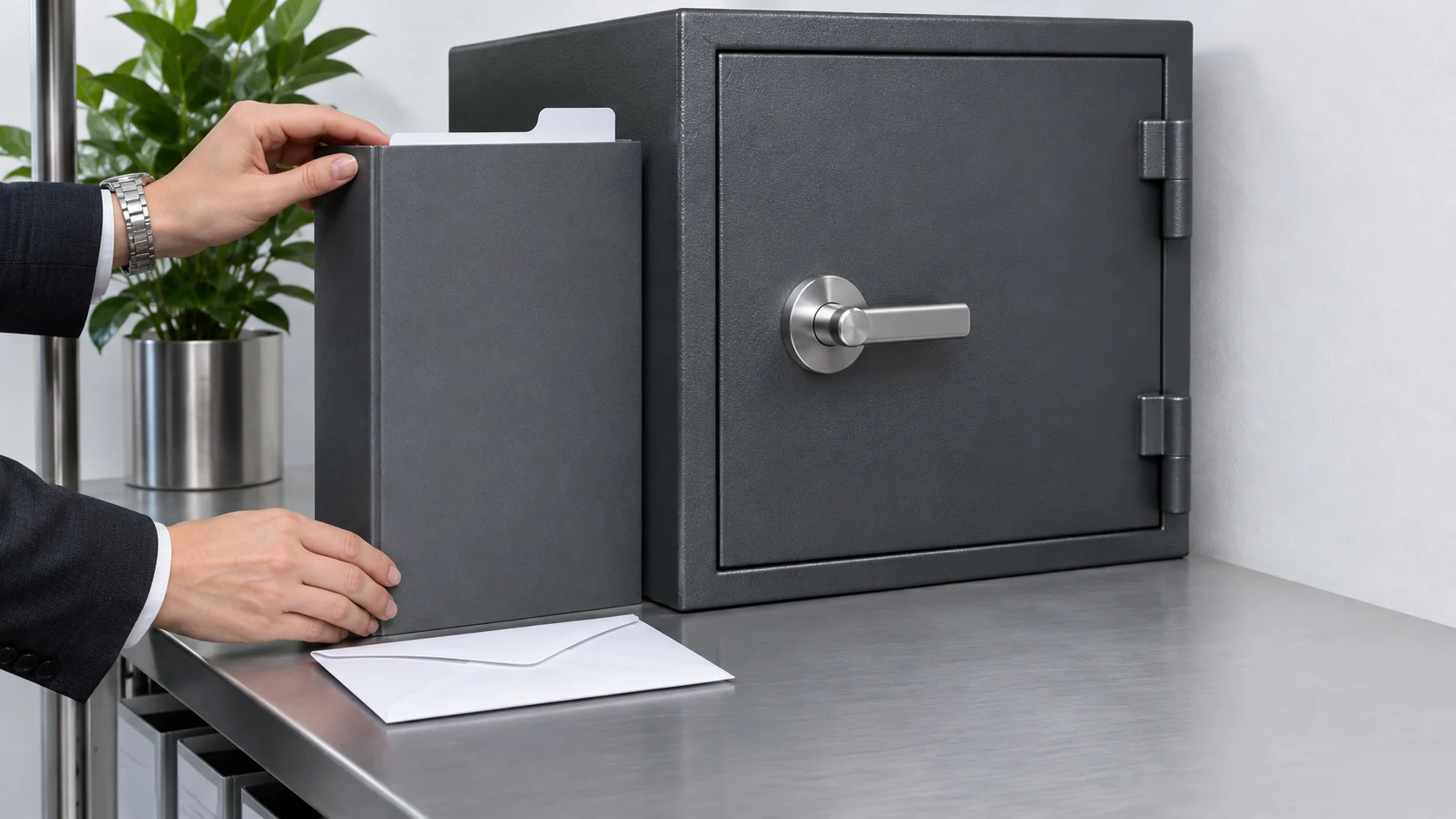

Valuables kept in a safe: inventory and records
A safe is physical property, while its contents can raise different insurance questions. For a company or person in the Republic of Moldova, assessment starts with ownership of valuables, general storage arrangements and documents supporting their existence and value. The presence of a safe alone does not confirm protection through an insurance policy.
This article concerns organising records, not selecting or operating security devices. It describes no opening methods, keys, codes, vulnerabilities or real locations. It does not confirm availability of a product for safes and valuables through ING Broker. Technical and legal details need separate verification with competent people, not conclusions from a general article.
Safe and contents are different categories
A safe's cost can be documented by its invoice, but that invoice does not identify its contents. For assessment, separate the storage device from valuables held. Do not automatically include contents in a general furniture or equipment value where the question concerns objects or documents of a different nature. Their evidence needs its own explanation.
Likewise, do not assume every item kept in a safe can be valued using one method. Cash, valuable objects and documents have different roles and evidence. An initial list can use categories without publishing a sensitive inventory. Establish the necessary detail after clarifying the purpose and confidentiality of the discussion.
Who owns and who stores the property?
Property may belong to the company, another entity or be received under an agreement. Keep the document explaining that relationship and do not infer ownership from physical presence. For rented premises or storage services, the exact contract holder can matter and must be checked. Use the actual entity name rather than an assumed owner.
A safe-deposit box, rented premises and a privately owned safe do not automatically describe the same relationship. Rights and obligations need review of the actual documents. This article assigns no liability to an operator or owner. In insurance discussion, ask whom the contract concerns and which interest is being assessed.
Prepare value evidence before incidents
For documented property, keep invoices, valuations and other relevant records in a controlled archive. Record the date and subject of each document. An old invoice or general estimate may answer a different question from a current valuation. The appropriate method follows competent assessment and the actual conditions considered, not an assumption from purchase price.
Do not publish detailed contents photographs or send originals through insecure channels. For an initial discussion, the type of property and existence of documents may suffice without every item's serial number. If a valuation or detailed list is requested, clarify the need, recipients and information-storage arrangements before transmitting the material.
Track inventory over time
A useful administrative inventory shows its date and version, not merely an unexplained total. When goods enter or leave storage, responsible people should update records under their own procedures. This article prescribes no operational frequency or access method. It recommends keeping documents capable of explaining the circumstances being discussed without revealing security routines.
Distinguish property held from planned purchases. An order does not establish receipt, and a photograph alone does not confirm ownership. Relevant records for transferred items should explain the relationship. A list without supporting sources may be a working document, but it should not be presented as a fully verified inventory.
Purchase price is not every later value
Historical value, accounting value and specialist valuation can differ. Before entering an amount, ask which basis is required for that property. Record the currency and document date. Do not present an informal estimate or online asking price as a value automatically accepted under a contract. The number needs a traceable basis, not merely a convenient entry.
For collections or groups of items, check whether a total duplicates objects already listed separately. For documents, the physical material's cost may not be the relevant economic question. This article establishes no universal valuation method. It explains why each amount requested should have a verifiable explanation and remain linked to the category assessed.
Confidentiality is part of preparation
Do not include exact locations, access-system photographs, codes or details of people holding them in a public form. An initial description can remain at category and document level. For necessary technical assessment, use agreed people and channels. Do not create a public collection of security details simply to obtain a preliminary commercial explanation.
An article's illustrative photograph is not evidence about a real safe or its contents. For your own file, images should be used only under arrangements established by specialists and with controlled access. Safety and information protection matter more than quickly sending photographs to obtain a general explanation. Do not confuse illustration with supporting evidence.
Check actual policy wording
Request definitions of the property and valuables concerned, not only a product name. Check limits, deductibles, period, territory and exclusions. Ask how existence is demonstrated and which valuation basis applies. Do not assume all these elements are accepted merely because marketing mentions valuables. A general category should not conceal an unanswered question.
For documents describing storage conditions, seek explanations through controlled channels. Do not publish details or turn this article into a recommended-device list. The premium is the amount paid for insurance; limits and deductibles serve other purposes. A paid premium does not remove the need to assess an actual case against its conditions and supporting facts.
Fire, damage and disappearance differ
When discussing an incident, separate observed facts from an unconfirmed cause. Damage to the safe does not alone establish the condition of all contents, and an inventory discrepancy does not explain its mechanism. Retain competent findings and records without improvised interpretations or accusations against an individual. The article does not conduct an investigation.
Do not assume every cause is included in property insurance. Ask for boundaries between risks and the notification procedure under the actual document. For safety and investigation, use competent professionals and institutions as appropriate. This article gives no instructions for opening, recovering or handling a damaged safe; administrative preparation is a separate activity.
Read storage contracts separately
For an external service, retain the contract, annexes and relevant handover documents. Check the exact entity and each document's role. Do not infer that an operator knows or guarantees contents merely because a use agreement exists. Actual rights and duties require legal analysis, not an interpretation supplied by this article.
If a partner presents an insurance certificate, ask what it attests and which conditions matter to your relationship. Another entity's document does not automatically establish acceptance of all your property and every cause. Keep written answers and distinguish commercial statements from actual conditions. A short certificate is not a universal guarantee.
Illustration: records describing different things
A business holds its own property and project documents in secured storage. Its archive contains the device invoice, but the contents inventory is older. The team separates those records and requests relevant updates without publishing goods, locations or access arrangements. The example illustrates different evidence categories without exposing a real security installation.
The scenario is hypothetical and concerns no real client. It explains why evidence about a safe is not evidence about everything inside. Each category would have its own ownership, value and conditions questions during insurance assessment. This article confirms neither acceptance of risk nor payment for any loss described in the example.
Discuss without unnecessary exposure
Start with three items: the category of valuables, your relationship to them and documents available. Prepare valuation, conditions and provider-role questions. Do not send a complete archive before agreeing what is necessary. A clear administrative explanation is more useful than sensitive photographs without context. The initial discussion should not become an unnecessary disclosure of contents.
Insurance ING Broker SRL is an insurance broker, not a safe supplier, security expert or universal valuer. An article being present in the catalogue does not confirm a product for every category of valuables. Availability and conditions require separate verification without absolute-protection promises or the use of sensitive client information in public material.
Documents without market prices
An archive may contain documents whose business importance is not limited to paper cost. For administrative assessment, describe categories and whether copies or other records exist without disclosing confidential contents. Do not assign a contractual value yourself or assume restoration costs are included in the same category as physical objects. Those questions need their own explanation.
Where restoration costs are considered, ask which documents and calculation basis are required. Do not automatically use the value of the project mentioned in a document as the loss arising from the document itself. These can be different exposures. This article determines no valuation method or policy treatment for any such category.
Items temporarily removed
For inventory administration, distinguish property in storage from items handed over for another purpose. There is no need to publish operations, people or schedules. Competent responsible staff organise records so the version used for assessment can be explained without revealing access details. An administrative inventory history should remain internal rather than becoming a public security record.
Ask which locations and situations an actual insurance contract describes. Do not assume an item receives identical treatment while stored, transported or used elsewhere. Documenting the relationship and period is more accurate than saying it was once in a safe. That description does not itself confirm eligibility or extend the proposed protection.
Frequently asked questions
Does an insured safe mean insured contents?
No automatic equivalence. Identify contents, values and conditions.
Is a photograph sufficient for value?
Not universally. Ownership and valuation evidence must fit the property and contract. Do not publish contents.
Should access codes be disclosed?
No. Never send codes, keys or access in public commercial discussions. Legitimate checks are separate and confidential.
Does a provider contract guarantee everything?
No inference is justified. Review legal relations and actual insurance limits.
Next step
Request a discussion with ING Broker to check assessment and intermediation possibilities. The broker explains options; acceptance, conditions and claims decisions belong to the insurer under the contract. This article does not confirm availability or individual cover.
Read also: Valuables in transit: a separate contractual relationship.
Sources and limits of this information
The Romanian source consulted this source on 15 November 2026. Lists are editorial recommendations, not policy conditions. Examples are not an ING Broker offer. Legal obligations and individual situations require specialist verification.