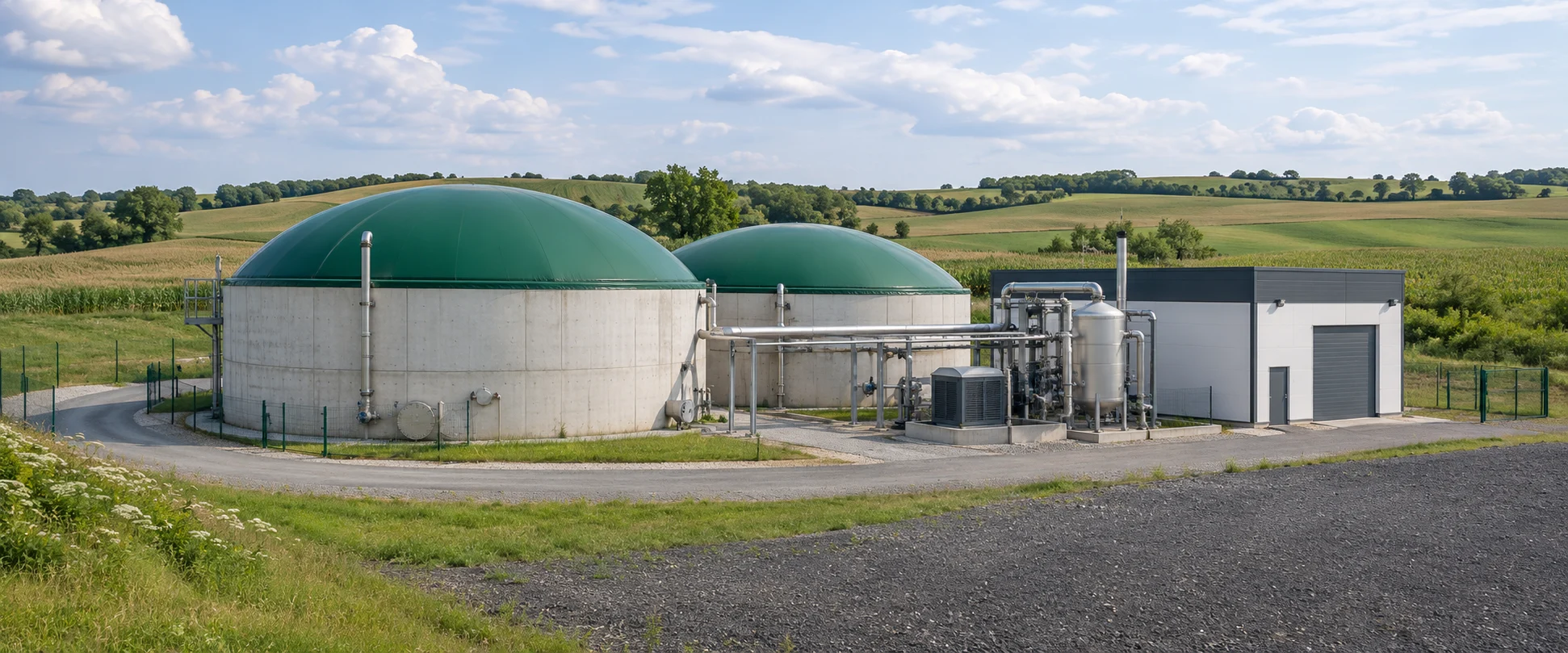

Biogas and biomass plant insurance assessment
A biogas plant and a biomass heating facility should not be described as identical equipment. Moldovan authorities present both among renewable sources, but actual projects have different configurations and processes. For insurance assessment, prepare the inventory, actual activities, contracts and consequences of interruption. A general description such as green energy is insufficient to assess the risk.
This material helps agricultural businesses, facility operators and investors organise documents. It does not confirm a policy for every process or provide operating instructions. Insurance, technical verification and authorisation have distinct roles. For an actual project, clarify assessment and intermediation possibilities, risk acceptance and conditions before making a commercial promise.
Start with the actual process
Describe in one page what enters the plant, which processes take place and which outputs are used or delivered. Have the technical team verify the description. Do not replace the project sheet with marketing about similar technology. If electricity and heat are both produced, explain their relationship and recipients without inferring insurance conditions.
For biogas, identify equipment for processing, storage, conversion and control separately according to your own documentation. For biomass, describe the actual facility and supply arrangements. Do not prepare a technical design outside your competence. The commercial file can use a simplified version without sensitive information about access or operation.
Record what belongs to the company and what belongs to partners. The facility, land, building and particular equipment may have different owners. Clarify these boundaries before identifying property for assessment. Co-location does not establish inclusion of every interest. Discuss owner, operator and financier relationships through actual documents, not photographs or the project name.
Organise inventory and values
Use categories recognisable in the project: buildings, equipment, auxiliary installations and stock where relevant. For each significant item, retain its identifier, value document and currency. Do not automatically add an entire assembly invoice to component invoices already included in it. Mark uncertainty about a value and ask the supplier or finance lead for an explanation.
Separate installed equipment from spare parts and property still in transit or being assembled. Design, transport and installation expenses may appear in different documents. Ask which valuation basis the proposal uses rather than treating the whole investment budget as an accepted sum. Update the list after actual changes and retain earlier versions to explain differences.
For property or materials that vary over time, describe the record-keeping method actually used by the company. Do not enter hypothetical quantities as existing stock. One day's photograph does not explain a year of operations. Distinguish documented information from internal estimates. Check availability and conditions of possible protection separately for the category concerned.
Supply affects continuity
Prepare relevant contracts and procedures for process materials. Who supplies them, which quality information is recorded, and what happens if a supplier cannot deliver? Do not present a supply shortage as an insured loss without checking the contract. For internal continuity planning, identify the affected operation and alternatives supported by documents.
Describe storage from the actual situation and existing technical documents. This article prescribes no distances, temperatures, handling procedures or safety limits. Specialists check them against applicable facility documents. For commercial discussion, gather completed assessments and checks, known deficiencies and measures being followed. Do not improvise tests or modify the plant to prepare insurance information.
Keep physical damage scenarios separate from commercial imbalance or delayed delivery. They may require different assessments. Equipment insurance must not be presented as a guarantee that production and supplies continue under every circumstance. In the working sheet, record the assumed cause and observable effect without independently deciding how the contract classifies them.
From construction to operation
Gather contracts with builders, suppliers and providers involved in commissioning. Identify each component's stage and available acceptance records. If one part operates while another is being expanded, do not describe the whole site as complete. Insurance assessment checks the accepted period and stage in actual documents; this article establishes no universal transition date.
Record acceptance reservations, unfinished tests and planned work. A supplier warranty does not alone confirm operation of the entire project or payment of every interruption consequence. Keep technical documents, commercial obligations and any policy distinct. Resolve contradictions before comparing offers or presenting circumstances to management as confirmed. An unfinished technical check should remain visibly unfinished.
Who responds to problems?
Prepare roles such as manager, technical lead, maintenance provider, equipment supplier and other competent parties for the project. Record contact channels and documents describing responsibilities. The list must contain no passwords or operational access. Do not assume one maintenance agreement concerns every component and every possible intervention. Check its actual scope separately from any insurance.
For a hypothetical repair, map inspection, diagnosis, part availability, provider access and post-intervention checks. Obtain appropriate confirmations rather than inventing deadlines. A component available from a supplier may still need other steps before use. In continuity assessment, distinguish what is known from what needs further checks. Planning recovery is not a promise of compensation.
Record known deficiencies factually alongside measures established by specialists. Do not rewrite history to remove an alert or unfinished intervention. If an event occurs, personal safety and competent procedures take priority. Follow the applicable contract for notification of a possible loss. This article sets no individual entitlement to payment or universal deadline.
What stops when the plant stops?
Describe what can no longer be produced, used or delivered in the scenario. If the project relates to a farm or another group activity, explain that relationship without automatically combining every loss. Keep project revenue, ordinary expenses and possible additional costs separate. An estimated budget is not evidence of a realised loss accepted under a policy.
For business-interruption discussion, prepare the documents used for calculations and the periods concerned. Ask which event could trigger protection, how the loss is established and which limits apply. Do not assume cover for missing input material, price movements or every production reduction. Find the answer in the actual proposal and check it against your own configuration.
Questions before choosing a proposal
Compare proposals using the same process description, property and period. Read risks and exclusions, meaning situations or risks for which the contract provides no cover. Check limits and the deductible, the share of a loss borne by the insured under the contract. The premium, the amount paid for insurance, should not be chosen independently of those elements.
For unclear answers, request the document and passage confirming the information. An empty field does not mean included. Ask for differences between the offer, annexes and general conditions to be checked. Insurance ING Broker SRL is a broker; the insurer accepts risk and decides claims under the contract. This article does not replace technical, legal or contractual assessment.
A sheet before the first discussion
Open a working document with four sections: process, property, continuity and contracts. For process, record what operates now and who checked it. For property, identify supporting identity and value documents. For continuity, record known dependencies and affected operations. For contracts, list existing agreements and questions for the proposal. Do not invent answers to fill the fields.
For each item, add a date and the person responsible for confirmation within the company. Their names need not be published. The sheet organises the internal file. If information cannot be verified, mark that openly and establish the next step. Hiding gaps in a confident commercial description does not make a complex project clearer.
A useful example is a component replaced after repair. The original invoice may describe old equipment, while maintenance records show the change. Link the documents and request confirmation of the current inventory. This editorial example is neither a claim file nor a universal acceptance condition. It explains why a current, coherent file is more useful than requesting an offer by total value alone.
Frequently asked questions
Is biogas assessed like biomass?
Do not begin only with the renewable-energy category. Describe the process, equipment, materials used and operation. Availability and proposal conditions must be checked for the actual plant, not inferred from similar names.
Does maintenance replace insurance?
Do not treat them as equivalent documents. Check which services and costs the provider undertakes. Warranty, maintenance and a policy have distinct roles; an answer about one cost does not confirm every consequence of interruption.
What should we send initially?
Process, stage, main inventory, roles and questions. Agree sensitive technical attachments separately, never passwords or operational access through a public form.
How do records stay current?
Update configuration, values, contracts and interventions after actual changes. Retain dates and sources rather than automatically reusing old files.
Next step
Request a discussion with ING Broker to check assessment and intermediation possibilities. The broker explains options; acceptance, conditions and claims decisions belong to the insurer under the contract. This article does not confirm availability or individual cover.
Read also: Photovoltaic panels: equipment and documents.
Sources and limits of this information
The Romanian source consulted these sources on 10 November 2026. Lists are editorial recommendations, not policy conditions. Examples are not an ING Broker offer. Legal obligations and individual situations require specialist verification.