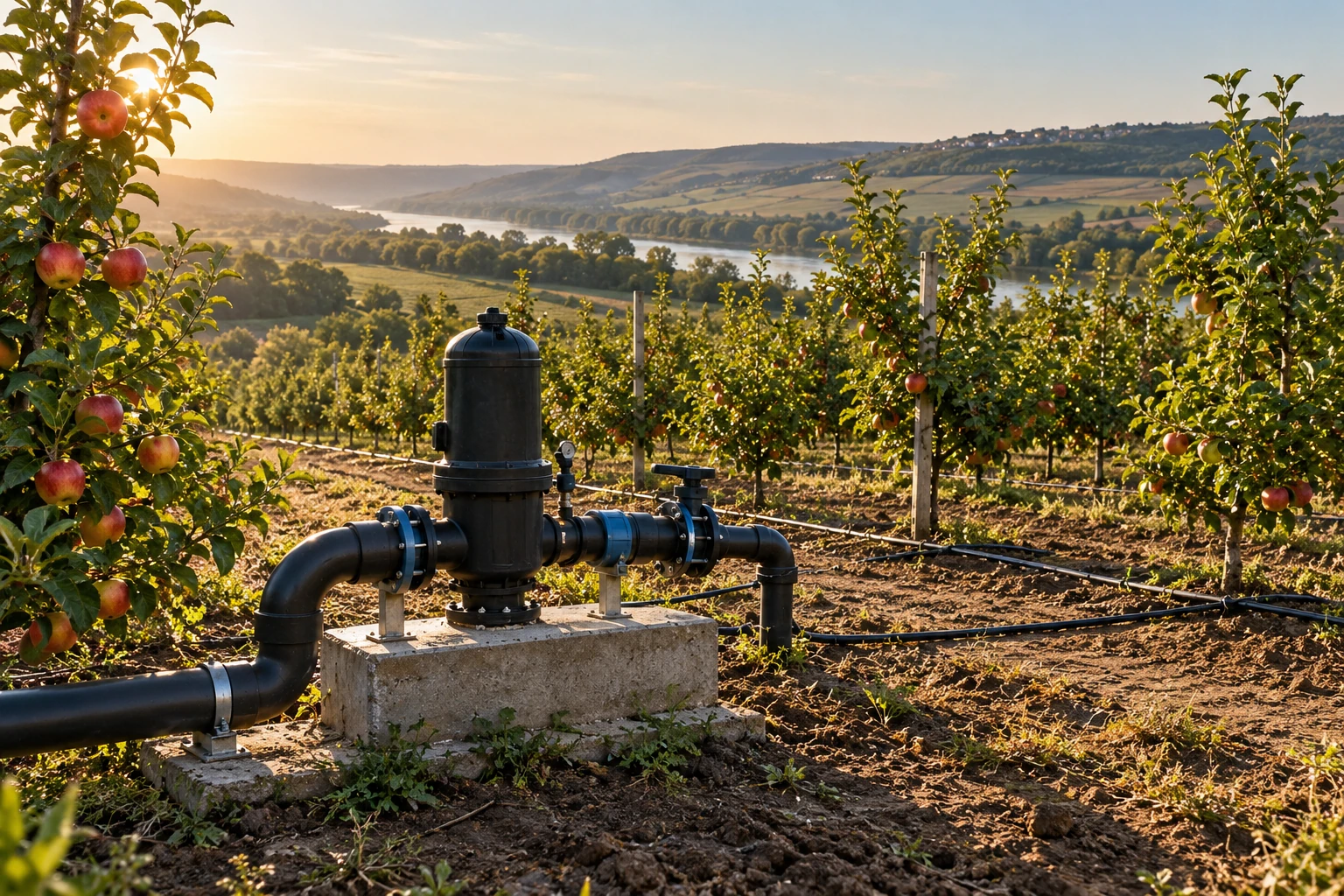

Irrigation system insurance: what to include in the inventory
For irrigation system insurance, describe the installation by component and site: pumps, electrical supply, pipes, controls and movable equipment. Damage to an installation and loss of a crop are different exposures. Do not assume one policy includes both.
An inventory useful to the farm and assessor
Divide the system into fixed equipment, movable equipment and components outside guarded premises. For each item, record its owner, year, documented value and place of use. Identify leased equipment and items shared by users, and check the relevant contractual obligations.
- Pumping stations and energy sources.
- Buried and surface pipes with available routes.
- Pivots, reels and other movable components.
- Sensors, electrical panels and controls.
- Off-season storage and intervention history.
Prepare an interruption scenario
Identify the component whose failure would stop the whole system, the alternative source of supply and the estimated time needed to obtain a replacement part. Then ask how the actual proposal treats mechanical or electrical breakdown, theft and natural events. Discuss wear, maintenance and the availability of water separately. Do not present these concerns as risks automatically accepted by an insurer.
Example record for a pump used on two plots
A farm uses one movable pump on two plots and stores it in a warehouse during winter. The working record has three locations, not just the company office. Note the equipment identifier, use periods on each plot, transport arrangements and storage address. Do not invent a value: attach the acquisition document and identify later accessories separately. This is illustrative, not a real customer or contract.
For each location, write the questions requiring clarification. Is temporary use accepted there? Are there transport conditions? How is movement declared? How is off-season storage treated? Keep answers alongside the policy rather than only in a phone conversation. If a situation is not accepted, the farmer can consider it operationally without assuming premium payment resolves every incident.
What to check at renewal after a claim-free season
A claim-free season does not mean that the installation has stayed unchanged. Compare the opening inventory with the current one: replaced parts, new sensors, additional land and repairs. Check the legal entity and use recorded in documents. Request a proposal based on reality rather than automatic copying. If a component value is unknown, retain it as an open question and request supporting records.
How to build the irrigation installation inventory
Start with the water route, not the farm's total value. On a working sketch, mark abstraction, pumping, filtration, distribution and served plots. For each point, state who owns and maintains the equipment. A rented pump, owned electrical panel and jointly used pipe do not automatically have the same position in insurance documents.
Give each important component a simple identifier and use the same identifier in the inventory, photographs and invoices. Where the installation has been extended in stages, retain the year and value of each extension separately. The proposal should not rely on an old invoice that no longer describes the present system. You do not need to publish the farm's plan online. Send it through the channel agreed for assessment of the file.
- Pumps and motors: model, serial number, year, power and installation site.
- Filtration and dosing: fixed parts, accessories and auxiliary equipment.
- Pipes: sections, material, location and buried or exposed portions.
- Automation: sensors, controllers, communications and panels.
- Movable equipment: operating sites, transport and off-season storage.
The installation and crop require separate discussion
A pump failure and a reduced harvest have different consequences. The repair cost concerns the damaged asset. The agricultural loss depends on the crop, the season and the relationship between the event and the outcome. Even if both occur on the same day, that does not establish that they are assessed under the same section of a contract. Prepare two distinct questions: what can be considered for the equipment, and what can be considered for the effect on production?
The MOLDASIG agricultural-risk page cited in the Romanian source mentions irrigation systems among the equipment considered. This local reference provides orientation, but does not confirm acceptance of your configuration or protection against a shortage of water. Describe both the installation and its water source, operating schedule and available alternatives. Ask for the answers concerning equipment and crops to be recorded separately.
Questions about electricity, weather and operation
Do not use one box labelled “all risks”. Describe events that could stop the system: a damaged motor, electrical panel breakdown, affected pipes or an incident during movement. Ask which are accepted and which excluded, meaning situations with no contractual cover. A photograph or generic product name cannot establish the answer.
Explain starting, stopping and supervision. Where electrical protection, pressure sensors or alarms exist, state how they are tested and who receives alerts. Describe cold-season storage and preservation. This information describes how the equipment is actually operated. The article does not establish a compulsory technical standard or a condition that applies to every insurer.
Identify work performed by staff and by service providers. Keep service records where available and note significant modifications. If the installation was adapted after purchase, explain the changes. A clear technical configuration helps avoid wrong assumptions before a proposal.
Declared value and replacement cost
Book value, purchase price and the current cost of replacement may be different. Ask which basis the proposal uses and which documents are needed to support it. For a part ordered specially, distinguish the price of the part from delivery, installation and commissioning. Do not assume these expenses are automatically included. Ask how each is treated and whether it has a separate limit.
A premium is the amount paid for insurance. An excess or deductible is the portion of loss borne by the insured under the contract. Compare cost with deductibles, limits and property lists. Proposals are not equivalent if one covers only a pumping station while another includes distribution. Use the same inventory version throughout.
Prepare before the season
Set an internal date for checking the policy before irrigation begins. Review additions, replacements and served plots. Confirm movable equipment locations and whether items were rented to other operators. Do not assume an old policy automatically follows every change. Request the declaration procedure and documents for updating.
Prepare operational contacts: farm lead, electrician, parts supplier and the person who can supply insurer documents. Avoid unnecessary personal information. Keep the list accessible to authorised staff, not in a public article. During a busy period, clear responsibility is more useful than a complete file nobody can locate.
Working scenario: the pump stops during the season
Imagine a pumping station stoppage without assuming it is insured. Record discovery time, observed symptoms, affected areas and the person intervening. Separate observations from hypotheses: “the motor will not start” is an observation; a competent person must establish an electrical cause. This is an organisational example, not an actual claim.
People's safety and limiting danger come first. Do not repeatedly restart unsafe equipment. Follow safety instructions and the contract's notification procedure. Record urgent interventions and preserve parts or relevant evidence safely according to instructions received. Do not delay necessary action to protect people just to obtain a photograph.
What to send for the first assessment
A useful initial message can identify the locality, type of installation, main components, year of commissioning and period of use. Explain whether you want only the property assessed or also the consequences of a stoppage. Agree a separate channel for detailed values and technical documents. Avoid sending a large archive without an index: a clear list of missing documents saves time for both parties.
When the proposal arrives, check that every point in your request has an answer. Mark each point as accepted, not included or still to be clarified. The absence of an answer is not acceptance. Before deciding, confirm the start date, policy period, information duties and contact for incidents. Assess insurance for the equipment alongside the farm's practical continuity plan, rather than treating insurance as a replacement for that plan.
Frequently asked questions about irrigation
If the pump stops, are affected crops paid too?
This does not follow automatically from pump insurance. Describe crop dependence and request exact boundaries between the contracts being assessed.
Does equipment remain included after moving to another field?
Check territory and movement declaration procedures before use. Keep location records.
What should I send for the first discussion?
An inventory, technical photographs without people, locations and maintenance description. Final documents are agreed during assessment, not established by this indicative list.
Next step
Request a discussion with ING Broker to check assessment and brokering possibilities. The broker explains options and acts as intermediary. Risk acceptance, conditions and claims decisions belong to the insurer under the contract. This guide does not confirm product availability or cover for an individual case.
Read also: Greenhouse structures, installations and crops.
Sources and information limits
- MOLDASIG: property, machinery and production interruption, a Moldovan example
- National Bank of Moldova: checking an insurance contract
- MOLDASIG: equipment and agricultural risks
The Romanian original records consultation of these sources on 7 November 2026. The translation revision date does not represent a new legal or product verification. Preparation lists are editorial recommendations, not policy conditions. Product examples from cited providers do not constitute an ING Broker offer. Legal obligations and individual circumstances require specialist review.